
Lyft: Massive Liabilities, Limited Capacity to Pay Them, and a Deteriorating Business Outlook
Initial Disclosure: Funds managed by Bleecker Street are short Lyft (LYFT). Please see the full disclosure at the end of this report, which covers our future trading plans.
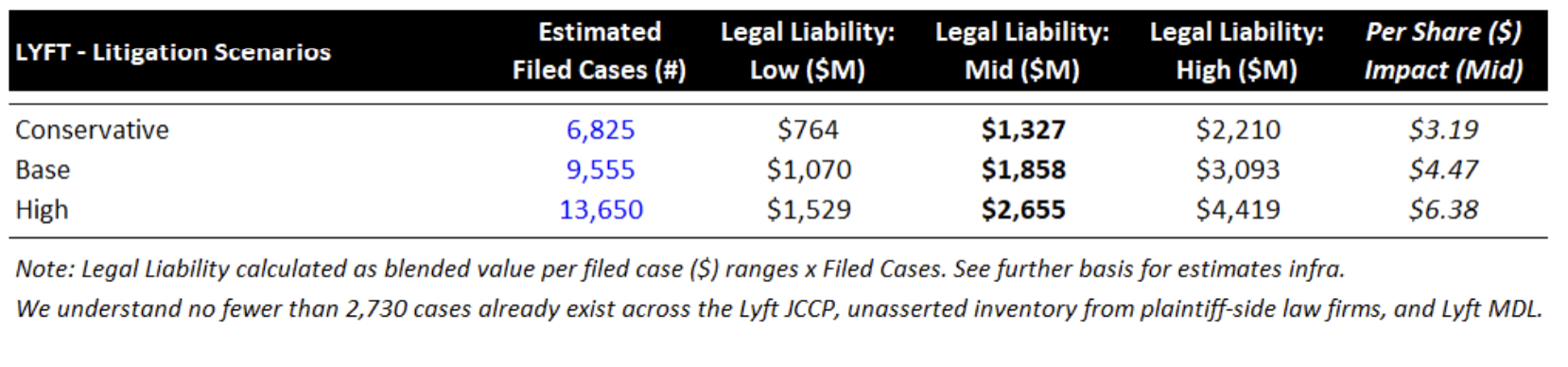
Lyft faces an estimated $1.3 to $2.7 billion of exposure from consolidated rideshare sexual-assault litigation against only $533 million of combined legal and tax accruals, of which little, if any, appears to be set aside for such claims. In fact, no specific sexual assault-related accrual appears on Lyft's balance sheet, which has only $1.7 billion of unrestricted cash and investments.
Lyft filed both its FY2025 10-K and its Q1 2026 10-Q without once disclosing that sexual assault cases against it had been consolidated into Multi-District Litigation No. 3171. Nor has it disclosed a quantified range for associated legal liabilities. Instead, it has only made a broad statement that for some liabilities, a range cannot be estimated to satisfy the minimum the ASC 450 standard asks.
ASC 450 requires accrual when a loss is probable and reasonably estimable. Lyft’s filings appear to lean on the claim that estimates are not possible, but plaintiffs have already shown they can win. In February 2026 a federal jury returned an $8.5 million, all-compensatory verdict against Uber on an apparent-agency theory. Lyft has a virtually identical operating model to Uber, and Lyft's first bellwether trial is set for September 30, 2026.
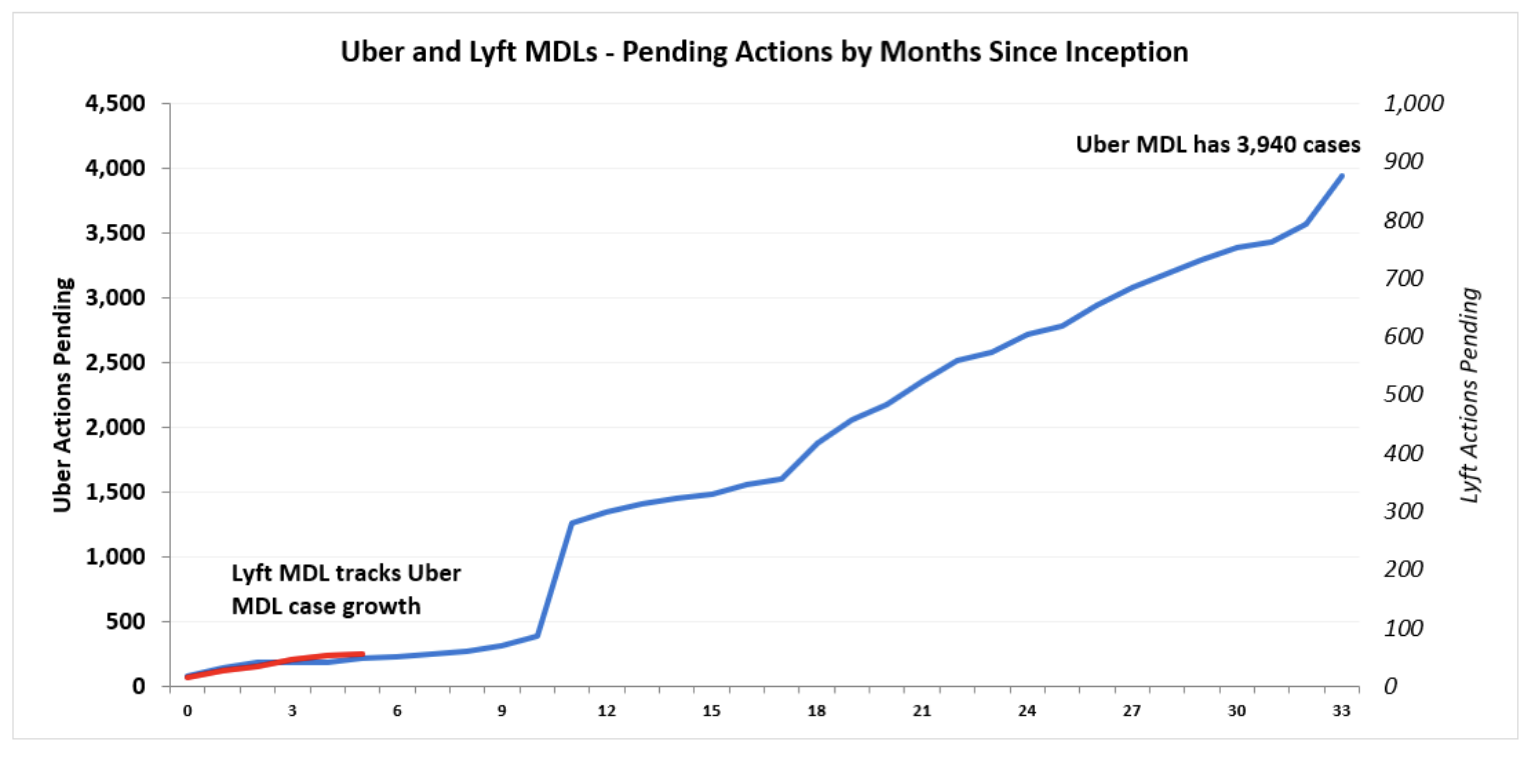
The Uber Multi-District Litigation (MDL) went from 79 cases to roughly 3,940 in under three years. The Lyft MDL, which is 5 months old, has 56 cases currently and appears on track for 1,000+, while there are 2,000 more cases already pending in the California JCCP and at least ~700 more retained by law firms but unfiled.
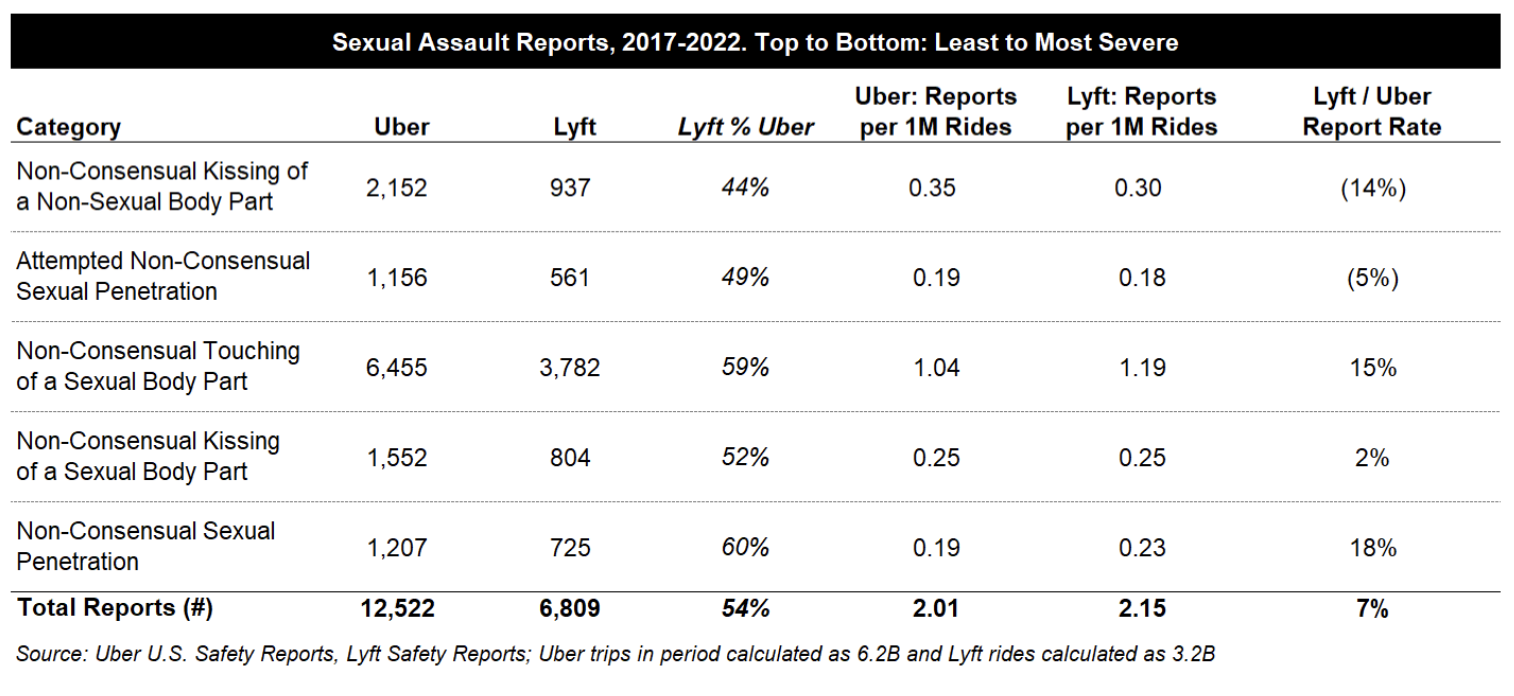
Lyft is roughly one-third Uber’s size but reports approximately 54% as many assaults. On a per-ride basis, Lyft’s safety record is materially worse than Uber’s. And while Lyft self-reported 6,809 serious sexual assaults over 2017-2022, this is a figure the company concedes understates reality.
Two former Lyft employees and multiple insurance executives told us third-party coverage for rideshare sexual assault is thin or effectively unavailable. Former employees stated that Lyft’s $2.3 billion of insurance reserves, which Lyft must pre-fund by a similar amount of restricted cash and investments, are commercial auto reserves.
The business underneath the liability is structurally second-rate. Lyft holds about 24% of the U.S. market against Uber's 76%, and it has resorted to chasing “underserved markets” and inorganic growth via international acquisitions of services businesses and low-growth assets prior owners did not want to retain.
Lyft has announced autonomous partnerships with nine companies since 2019, with little to show for any of them. Partners have shut down, missed timelines, or defected to Uber.
Lyft’s flagship deal with Waymo announced in September 2025, which sent the stock up 20%, is not a platform partnership, but rather a lopsided excess supply utilization agreement with a low-gross-margin services contract. And unlike Uber’s Waymo deal, Lyft’s is not exclusive.
Introduction
Lyft (LYFT) is the structurally second-place rideshare operator, and it carries a mass-tort liability that does not appear to exist on its balance sheet. It holds roughly 24% of the U.S market against Uber’s 76%, and primarily sells a single product in what was, until recent acquisitions, a single market. Unlike Uber, it has no delivery, freight, or scaled advertising offering to fall back on.
Like Uber, Lyft is facing a coming wave of litigation related to sexual assault incidents that occured on its platform. Uber has disclosed this; Lyft has not. We estimate that Lyft has $1.3 to $2.7 billion of liability from pending and prospective sexual-assault claims. The claims sit in two proceedings: MDL No. 3171 in the Northern District of California, created in February 2026 and holding 56 pending actions as of July, and JCCP No. 5061 in California state court, which has gathered roughly 2,000 cases since 2020.
Uber’s parallel docket provides a roadmap for Lyft’s claim liability. Uber’s MDL No. 3084 was filed in the same district and began at a comparable size. As of July 1, 2026 it holds roughly 3,940 pending federal cases and 778 in California. Uber’s litigation started earlier than Lyft, and we expect Lyft’s docket to follow the same arc. Plaintiffs have already shown that they can win: in February 2026 a federal jury awarded $8.5 million, all-compensatory verdict against Uber. Lyft’s first bellwether trial, in the California JCCP, is set for September 30, 2026.
Lyft is poorly positioned to face any of this. Lyft has not booked any quantifiable reserve. Its language in the last five filings has not changed even as the docket has grown. Lyft did not mention the federal consolidation into MDL No. 3171 in either the FY2025 10-K or the Q1 2026 10-Q it filed after the MDL was created.
We Believe Lyft’s Undisclosed Legal Liabilities Fall in the Billions
We believe Lyft faces a massive legal liability from 6,000+ prospective sexual harassment and assault cases. We estimate Lyft’s sexual assault litigation liabilities are $1.3-$2.7 billion, and Lyft appears not to have accrued for this exposure based on its disclosures. In February, a jury awarded $8.5 million to the plaintiff in an Uber sexual assault case, which Uber is challenging. Lyft has the same ridesharing business and attendant risks as Uber, but without Uber’s balance sheet or diversified business model. We believe these disadvantages mean Lyft will struggle to swallow a multibillion-dollar liability.
In May 2018 it voluntarily ended mandatory arbitration for sexual-misconduct claims, which means every such case since then can go to a jury rather than a confidential arbitration. California courts, where both the federal and state cases sit, are also increasingly applying the "common carrier" standard that holds transport providers to the highest duty of care. Together these mean that Lyft faces sympathetic juries and a higher legal bar, and it cannot reverse the arbitration waiver.
We view it to be likely that Lyft will have to raise dilutive financing, a sharp departure from the ~$800 million in buybacks that have helped prop up the stock since last year. Insurers pulled back from covering sexual assault; two former Lyft employees told us Lyft would be on the hook for all or the majority of assault claims. Lyft’s available cash, meanwhile, falls short of our base-case estimated liability.
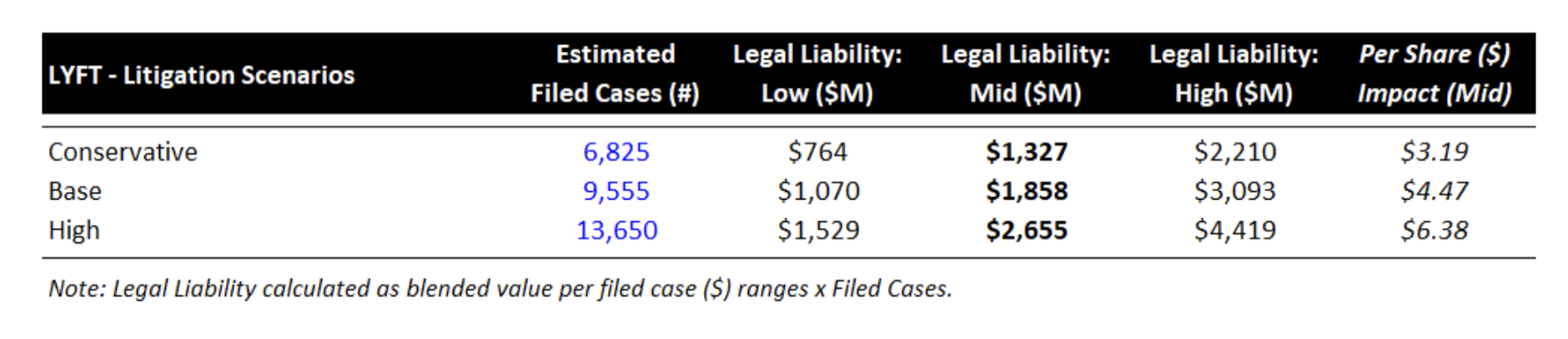
Below is our estimate of total sexual assault and harassment litigation liabilities, which range from $3.19 - $6.38 per share:
We Believe Lyft Faces a Wave of Sexual Assault Suits In the Wake of Its First Bellwether Trial In September
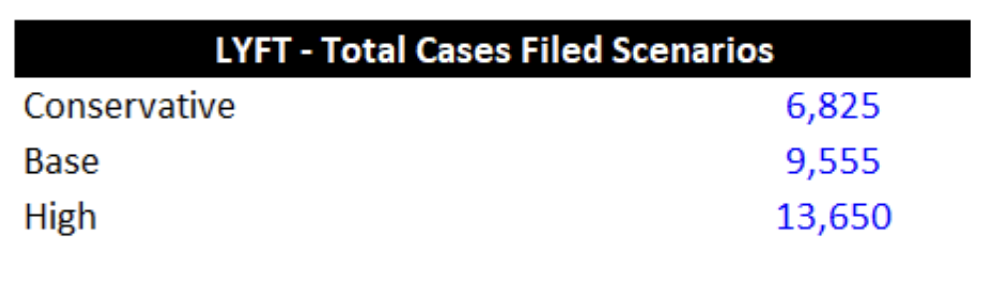
We expect the number of filed and retained cases against Lyft to grow considerably in the coming months to an eventual 6,000+. Today, Lyft is defending over 2,000 sexual harassment and assault cases filed publicly. We understand that on top of these, at least ~700 cases are retained by plaintiff-side law firms but not filed. We believe that consistent with other mass torts, the pace of case filings will multiply as more bellwether trials conclude with monetary judgments. The first bellwether case against Lyft is expected to go to trial in September.
Lyft sexual assault and harassment cases sit chiefly in two venues today. The Lyft Judicial Council Coordination Proceeding (JCCP) in California state court has grown to roughly 2,000 cases since its inception in 2020. The Lyft Multi-District Litigation (MDL), a separate federal proceeding created in February 2026 to house sexual harassment and assault claims against Lyft, has 56 pending cases as of July. We believe the older Uber MDL is a blueprint for the Lyft MDL’s growth. The Uber MDL was created in October 2023 with 79 cases and has since grown to 3,940 cases as of July 1st, 2026. The Lyft MDL is growing at similar rates to the Uber MDL, putting it on track for 1,000+ cases:
In the days and even hours leading up to key decision dates for mass settlements, case totals can grow quickly. For example, Los Angeles County claims pursuant to AB 218, which expanded the statute of limitations for childhood sexual abuse beginning January 2020, numbered 3,000 at the beginning of confidential mediation in April 2023. By the time of the first settlement announcement in April 2025, there were 11,000 claims. The initial settlement itself triggered a further 6,000 claims as of April 2026.
Lyft is now facing sweeping discovery demands, such as an August 17 MDL deadline to produce all documents it has previously given to government agencies about sexual assault. Its September 30 bellwether JCCP trial date is also drawing near. These transparency and case progression milestones contribute to a snowballing claims total as matters get decided, and we believe that eventual sexual assault and harassment claims against Lyft will be multiples higher than what is currently filed. We multiply the current cases known to us by 2.5 at the conservative end, 3.5 in our base scenario, and 5 at the high end to arrive at our estimates.
Lyft reported 6,809 serious sexual assaults over six years, 2017-2022, with only a 5% decrease from the first year to the last. The total number of Lyft sexual assault victims is likely to be significantly larger: Lyft itself has stated that sexual assault incidents are “chronically underreported in the United States”. Lyft’s reported incidents also compare unfavorably to Uber’s, with a 7% higher serious-assault rate per trip and an 18% higher rate of the most severe assaults:
Past Settlements Indicate Per-Case Liabilities Will Run Hundreds of Thousands of Dollars
We used prior settlements to compute an estimate of Lyft’s per-claim legal liability, which is $194,500 at the midpoint. We divide claims into 4 different severity tiers, aligning approximately with the categories in Lyft’s Safety Transparency Report, and estimate a proportion of cases in each. We assign an estimated low-mid-high dollar liability range to every tier based on settled cases:
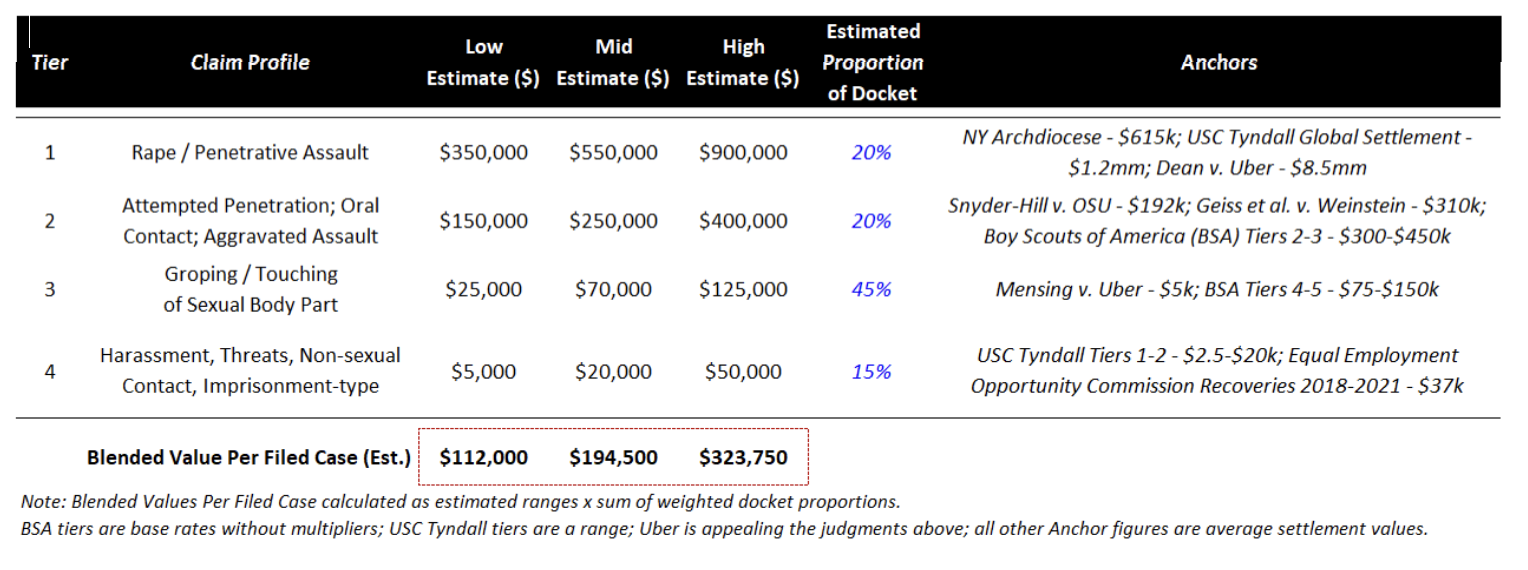
To establish our range of estimates for Tiers 1-4, we evaluated a body of sexual assault and harassment settlements (available here) and computed average per-claim values for each severity tier. We also assigned aggravated assault and unlawful imprisonment to Tier 2 and Tier 4, respectively, while Lyft does not disclose them separately in its safety reports other than in the case of fatal assault. We assume filed cases skew roughly 2x more severe than the proportions in Lyft’s reports, as Tier 3 and 4 claims are less likely to be filed due to the time and effort involved.
We also note Uber’s bellwether cases and their relation to our estimate bands. One of them was an $8.5 million verdict for rape in February 2026, which we put at 9.4x our High estimate of eventual Tier 1 per-case liabilities. The other bellwether that found for the plaintiff called for $5,000 in damages in April 2026 for inner thigh touching and verbal harassment, which we place at 0.2x of our Low per-case estimate.
We multiply our per-case estimates by our filed case scenarios to arrive at an estimate of the total associated legal liability for Lyft. At the midpoint of per-case liabilities, we estimate $1.3bn in the Conservative scenario, $1.9 billion in the Base scenario, and $2.7 billion in the High scenario:
Lyft Appears to Be on the Hook for Most or All of These Sexual Assault Liabilities…
We understand that Lyft will have to pay most or all of the estimated multibillion-dollar legal liability, and given its balance sheet, it appears likely Lyft will have to raise equity to do so. We spoke to insurance executives and two former Lyft employees who confirmed that insurers have been backing away from writing sexual assault policies for rideshare since the end of the last decade. As a result, Lyft appears to be liable for the bulk of associated legal exposure.
Insurers have long known about the elevated risks related to rideshare companies, apparently prompting Lyft and Uber to retain most of the liability for sexual misconduct claims. In 2019, Uber’s primary commercial auto insurer, James River Insurance, terminated its relationship with Uber due to lossmaking policies and expanding risks. It has become more difficult for rideshare companies to insure tail risks, especially risk pertaining to sexual misconduct:
“For those kind of higher layer losses, the excess losses, those kind of sexual assault losses… the [insurance] market has not viewed those very favorably. They are high-profile, and so they see headlines and certain settlements come across in the news for really high amounts and/or big class action lawsuits, and really for the most part they’ve shied away from touching it.”
–Former Lyft Manager A
Based on our conversations with rideshare insurance industry participants and former Lyft employees, it appears Lyft is directly financially responsible for all or most of its sexual assault and harassment liabilities. Lyft carries multiple layers of insurance, both third-party coverage and those risks that Lyft self-insures and retains. Rideshare companies’ insurance provides coverage for, in rough order of severity, commercial auto exposure, then general liability, then umbrella coverage and/or excess liability policies. However, Lyft appears to carry minimal third-party coverage for sexual assault because insurers either exclude sexual assault from policies entirely or demand narrow payout parameters and high prices.
Current and former industry executives told us that insurers are leery of writing sexual assault and harassment coverage. They stated that insurers are likely to exclude sexual assault coverage entirely or limit coverage to a claims-made basis, meaning only claims filed while the policy is active are eligible, and once the policy ends, further claims will not be covered. The executives believed reinsurers would cap their exposure through sublimits to such claims, if any, at a fairly low number, leaving Lyft responsible for the majority of the liability:
“That’s probably the hardest coverage… in the industry, and a lot of it is a result of maybe 5 years ago or less, a lot of the states have changed laws [around] the sexual assault statute of limitations - so yeah, it’s a whole different environment right now.”
- Insurance Industry Executive B
“The primary general liability forms have excluded sexual molestation for a long time, a few decades… the way most reinsurers have responded to sexual molestation and some of these, I call them esoteric coverages, emerging risks, they'll either exclude it completely or they'll have a sublimit of some kind… Sexual molestation might be limited to a hundred million [dollars] in the aggregate, say, on a claims made basis.”
-Former Reinsurance Industry Executive C
And two former Lyft employees we spoke to stated that Lyft’s is directly exposed to all or the majority of its sexual assault liabilities:
“The insurance is all for traffic safety, auto accidents… Sexual assault incidents, that is completely separate. The insurance doesn’t cover that.”
–Former Lyft Manager B
“Coverage for those kind of claims [sexual assault and harassment claims] is really hard to come by… if they can get any kind of relief, it’s going to be expensive.”
–Former Lyft Manager A
When it comes time to pay sexual assault and harassment claimants, it seems Lyft will have to tap equity markets. Our base scenario midpoint liability estimate of $1.9bn exceeds Lyft’s Q1 2026 cash and investments balance of $1.7bn, and is 1.6x Lyft’s TTM FCF. And unlike its diversified competitor Uber, which is rated A- by S&P, we believe Lyft will be unable to raise enough debt alone to digest an estimated settlement that in Lyft’s case is roughly 25-45% of its current market cap and 2.5x-5x 2025 EBITDA.
The former reinsurance executive we interviewed opined that Lyft would have to raise capital in order for it to cover sexual assault and harassment claims numbering in the several thousands:
“My guess is that it's undercovered and there will be some kind of an unplanned retention at that point…. I would imagine that they will go to the market and get additional capital”
-Former Reinsurance Industry Executive C
We note as well that Lyft’s $2.0bn in restricted cash and investments is used to collateralize Lyft’s insurance obligations, which are primarily commercial auto insurance, as we discuss below in the context of insurance reserves. We believe such funds cannot be released easily or in sufficient quantity to pay sexual assault or harassment claims.
In fact, even as Lyft appears inadequately prepared for a multibillion-dollar sexual assault claim exposure from a cash perspective, the company also seems to have few, if any, balance sheet reserves or accruals for related legal exposure.
… But With Few to No Apparent Accruals, Potential Liabilities Stay Off-Balance-Sheet While Lyft Pursues One-Off Settlements
Lyft’s legal accruals related to sexual assault and harassment appear to be small or nonexistent, which is why, as we understand it, Lyft seeks to settle a small number of low-severity cases quietly each quarter, subject to an informal cap. This behavior seems to be the result of an application of ASC 450 that, in our opinion, allows the company to grossly underreserve for an estimated multibillion-dollar legal liability.
Lyft’s balance sheet does not have an explicit reserve or accrual for sexual assault cases. The company’s filings hardly deal with the cases at all, other than citing the existence of the JCCP.
Instead, the filings make reference to the ambiguity of potential legal liabilities:
“For certain matters for which a material loss is reasonably possible, an estimate of the amount of loss or range of losses is not possible”
–Lyft Q1 2026 10-Q, p. 20
We believe Lyft uses this disclosure to justify not accruing for sexual assault and harassment-related legal liabilities. Based on our interviews of a former Lyft employee and a former Big 4 audit partner with knowledge of insurance accounting, legal teams have significant subjective input to legal accruals under ASC 450, which can allow even multibillion-dollar potential liabilities not to be discussed or disclosed.
The accounting standard provides just enough cover, in our view, for lawyers to deny the existence of a need to accrue. ASC 450 stipulates that if a potential loss is probable and reasonably estimable, the issuer must accrue for the estimated loss. However, if an estimate cannot be made, then the issuer need not do so.
Lyft’s disclosures about the sexual assault and harassment claim against it appear to be more of a legal ploy than an attempt at an accurate representation of Lyft’s financial position as a result:
“That’s the whole point of ASC 450, is to say even if you haven’t received a settlement ask from the other side, if there are reasonable cases out there, like a case pattern, a lawyer should be telling you, ‘Hey, these cases settle for $8 million’, and that is reasonable information under ASC 450.”
–Former Big 4 Audit Partner
And, indeed, legal accruals appear to have been roughly flat at Lyft despite ballooning sexual assault and harassment case totals against it. Excluding a seemingly unrelated Q4 2025 accrual which was booked mostly against revenue, not as general and administrative expense, legal reserves were flat over the past two years and down over the last three:

Most of the Q4 2025 booking was contra-revenue, so it appears to us to be primarily a rider-refund or VAT dispute-related accrual. In fact, Lyft recorded a $23.3mn SG&A decrease YoY pertaining to “loss contingencies including legal and tax accruals and settlements”. It seems that Lyft’s legal accruals do not contain a significant reserve, if any, for sexual assault and harassment-related claims.
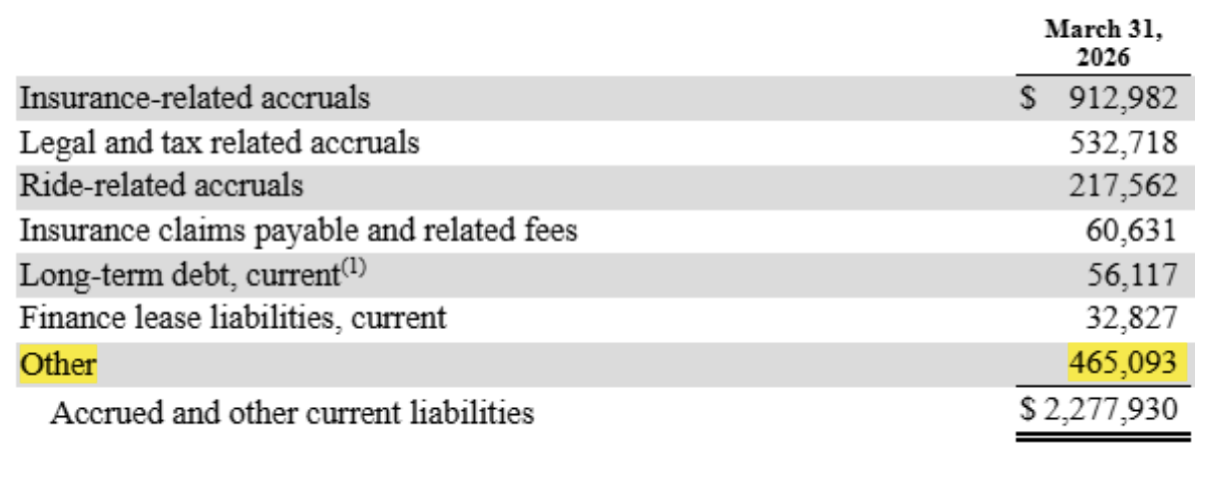
Nor does Lyft appear to be burying a sizable litigation reserve or accrual elsewhere on its balance sheet. Its $2.3bn in insurance reserves and $900mn in insurance-related accruals as of Q1 2026, which are computed by actuaries, deal primarily with commercial auto insurance, and would not house sexual assault and harassment-related legal accruals, per two former Lyft employees. There are few other places a reserve or accrual might hide: the company stated $217.6mn of ride-related accruals in Q1 2026, but a former Lyft employee we asked about this line item, which has been flat since 2023, stated it was unlikely to be related to sexual assault. Finally, the company has an “Other” accruals item amounting to $465.1 million, but given it follows a $32.8 million liability that previously sat within Other, we believe any potential reserve or accrual within “Other” would be miniscule:
In our view, Lyft is relying on ambiguity within ASC 450’s estimability parameters to avoid taking a disclosed accrual for legal exposure relating to sexual assault and harassment.
At the same time, however, Lyft seems aware of the large body of claims and willing to cut deals behind the scenes on smaller cases. We understand that Lyft discusses potential sexual assault and harassment settlements with plaintiff firms, with an apparent ceiling on payouts, perhaps due to profitability pressure. This repeat dynamic, if it is indeed the case, would contradict Lyft’s lack of liability disclosure and suggest that there is already a market for certain kinds of Lyft assault claims.
Lyft Is A Structural Loser, Second Place In U.S Rideshare And It’s Not Getting Better
Lyft’s underlying business is headed in the wrong direction to absorb these liabilities. In Q1 2026, Lyft posted revenue of $1.65 billion, a GAAP operating loss of $5.3 million, and net income of $14.2 million that rested on $32 million of interest income rather than operations. Adjusted EPS of $0.04 missed the $0.07 consensus, the second consecutive miss after Q4's shortfall in exactly the period the 2027 plan needs the opposite. After ceding the ridesharing market to Uber in the U.S. with ~24% market share against Uber’s ~76%, Lyft has resorted to launching in “underserved markets” including college campuses and inorganic growth via international acquisitions of chauffeur and taxi services, bike rentals, and billboards campaigns to remind users to check their prices against Uber.
Lyft's top-line acceleration since mid-2025 is substantially acquired, and the pattern of what it acquired is telling. In each case Lyft bought a business its prior owner was trying to exit, at a price that reflected the seller's motivation rather than the asset's quality:
FreeNow, the European taxi app, for roughly $197 million in Q2 2025, about ~0.175x bookings, after Mercedes and BMW had run a Lazard process seeking around $521 million in Q1 2025. The business was recently near breakeven and pulling out of markets with flat growth in 2024
TBR Global, a chauffeur and event coach bus operation, for roughly $110 million, of which the CEO said there were no integration plans, and thus no real synergies, and whose directors paid themselves multimillion-dollar dividends and resigned before the sale.
“TBR is much more high-touch – specialist, complex events, financial roadshows… a high level of offline bookings. There won’t be an integration but there is an opportunity to share business.” - Craig Chambers (TBR Global CEO)
Gett's loss-making U.K. unit, an asset that had already passed through several distressed hands and had been carved off by its own parent less than 6 months after acquiring it for sale as reported in Q1 2026 before Lyft took it for ~$82 million in Q2 2026.
A portfolio of municipal public-bike contracts for operational services and supply from Serveo, for a reported €40 million-plus, which the seller was divesting to refocus elsewhere and that Lyft already had exposure to from prior partnership agreements with the seller.
When asked about international and organic growth, management has avoided the topic:
“And then I think you had a question, I know about kind of organic expansion maybe into new markets internationally. And I think that's probably one we're not going to talk too much about.”
– Lyft Q1 2026 Earnings Call
Based on the acquired entities’ local financial filings and contracts (available here) we estimate that Lyft's organic growth declined to ~10.4% in 2025 and that the new subsidiaries will contribute ~$333 million of revenues to 2026, implying organic growth declining to ~9.4% against consensus estimates for total growth.
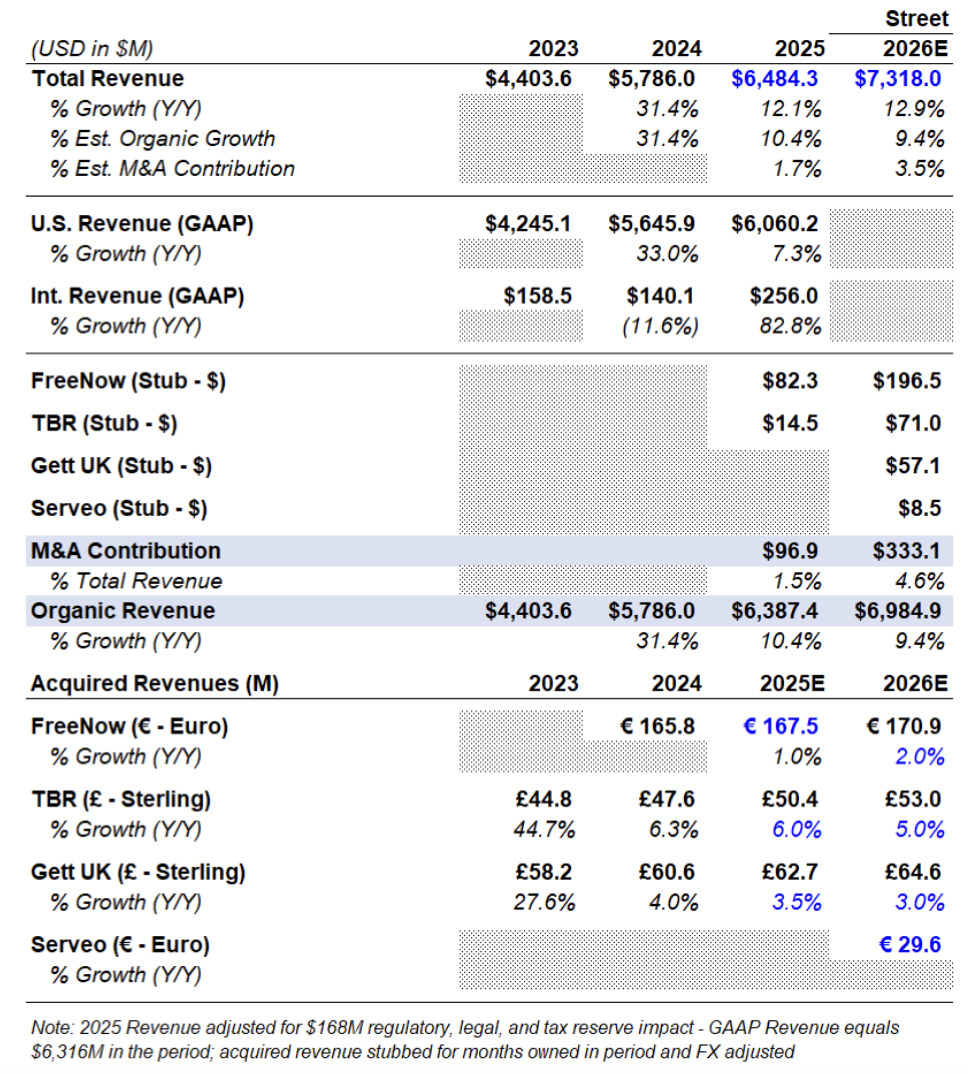
We believe without this rapid clip of acquisitions, Lyft would fall even further short of its established long range growth targets and near term growth guidance for 2026. With two out of the four businesses effectively offering services or operations and the firm recently expanding its KPI definitions for gross bookings, rides, and active riders in Q4 2025, it seems the core marketplace of ridesharing is out of gas.
Lyft Losing San Francisco: Declining Market Share In Its Backyard
San Francisco has been Lyft's strongest market for most of its history - the one city where it approached competitive parity with Uber. Before Waymo launched city-wide, Lyft held approximately 34% of San Francisco rideshare bookings. By June 2025, YipitData analysis showed Waymo had grown from zero to over 25% market share, surpassing Lyft to become the city's second most-used ride-hailing service. Lyft's share had fallen to approximately 21%.
Long pitches on Lyft, as well as management, argue that autonomous is not an issue: a rising tide lifts all boat:
“So broadly speaking, as we've said before, we think AVs are an incredible positive for rideshare. And really, it's because it's a great product. And therefore, you would expect over time, that's going to bring new people on to the -- sort of into the rideshare ecosystem. And when we look across sort of in aggregate, all of the regions where AVs are in the marketplace, we've effectively held share pretty steady. So that's kind of a good [indication] because it means that as new riders are coming on, still the whole pie is growing… As we said, we actually had an increase - we've had nice growth in San Francisco. But broadly speaking, I feel pretty good about our position in SF.”
– Lyft Q1 2026 Earnings Call
Yet when discussing with former Waymo employees and on the ground operators, they shared that pie growth was not material, as the expansion was attributed to use cases outside of ridesharing such as transporting children, and that in fact market capture was the common reality across new city launches:
“Initially we’re taking a little bit of share from the ride hailing market and the pie doesn’t really grow because the fleet itself isn’t that big and the amount of customers we can service reliability isn’t that big. Then over time we’re able to take more market share both from the ride hailing players and also the pie grows because we see customers using Waymo for different use cases they wouldn’t use ride sharing services for depending on the market.For example, sending kids to school every day or using or courier services if [users] don’t necessarily trust the drivers.”
- Former Waymo Operations Manager
“On increasing the size of the pie - In early deployments and reports, the growth of use cases is there but it’s not a huge bump - maybe 15-20% of activities that would not have happened or would’ve been monetized in a different way, things like taking your son to soccer practice in a Waymo. But it’s not doubling the market or 50% increase to the overall TAM. However, on market share capture that’s where I think the most dramatic outcomes we’ve seen - even a year ago in SF we saw Waymo surpass Lyft’s market share with a somewhat limited presence. If in one of the most competitive markets in the U.S., in fact the birth of ridehailing itself - Waymo can come in and in two years eclipsed the markets hare of the #2 player in the industry, that’s amazing when you factor in that Waymo’s wait times and pricing are higher than other players in the industry.”
- Former Waymo Strategy Manager
Furthermore, for existing city operations such as San Francisco the rate of share capture to date has been constrained by fleet inventory up until this point, as the Jaguar I-PACE vehicle model used in Waymo fleets ceased production in 2024 with Waymo taking final delivery in May 2025:
“I think in all of their cities, they don’t know what the upper limit to their market share capture is because they’ve been supply constrained up until recently, and even now, as they had a fixed amount of fleet. The Jaguar they’re using stopped being manufactured a couple years ago so whatever they have is what they have, they can’t add more vehicles to the fleet so they’ve had to spread that fleet strategically rather than saying let’s just keep adding vehicles to see where we can push on market share or economics - so in every market they’ve been in a suboptimal vehicle position.”
- Former Waymo Strategy Manager
This directly contradicts what management tells investors about market share stabilization, pie growth, and steady rideshare demand when autonomous vehicles enter a market. Actual operators hold the exact opposite view management has been reassuring shareholders with at every point. On July 8, 2026 Waymo announced the deployment of its next generation Hyundai IONIQ 5 vehicles in multiple cities. We expect market share dynamics for ridesharing in existing markets to destabilize and new launches to deteriorate at a faster pace as a fresh multi-year supply of fleets with greater availability begins to roll out.
Lyft’s Six-Year History Of Falling Short On Autonomous, Leaving Behind a Graveyard of Failed Deals
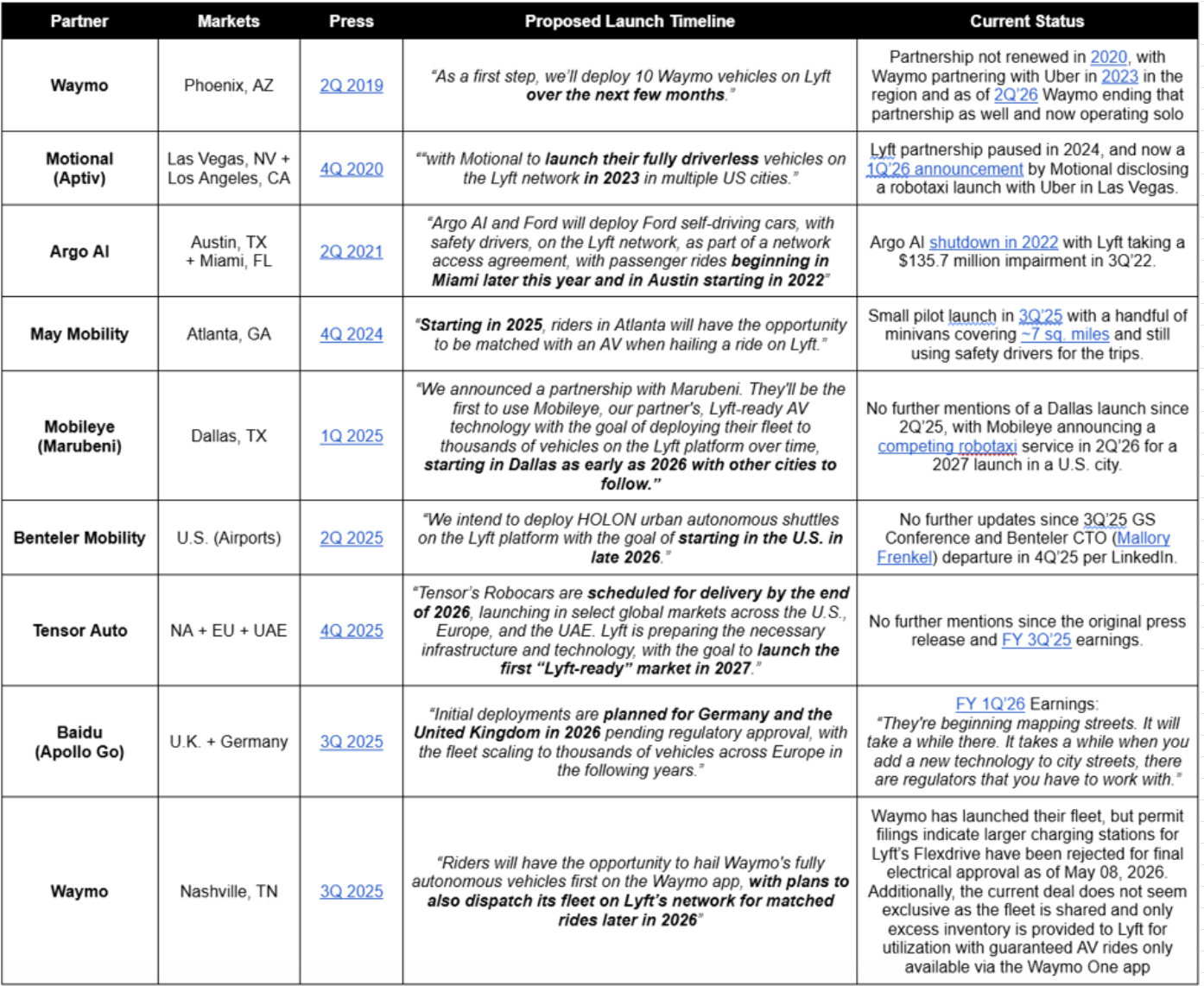
Since 2019, Lyft has announced autonomous partnerships with nine separate companies. The pattern across all nine is consistent: press releases announcing aggressive deployment timelines, followed by silence, failure, or the partner announcing a competing arrangement with Uber.
In 2019, Lyft announced Waymo would deploy vehicles on its platform in Phoenix. By 2020 that arrangement had been quietly dropped. In 2020, Lyft announced Motional would deploy “fully driverless vehicles on the Lyft network in 2023 in multiple US cities,” beginning in Las Vegas.
However, Motional would shut down and pause all partnerships in 2024, announcing it would go through a restructuring. In 2026, Uber announced it was partnering with Motional again to enter the Las Vegas market. Lyft was nowhere to be found.
In 2021, Lyft sold its Level 5 autonomous vehicle division to Toyota for ~$550 million. Lyft exited the autonomous race at the exact moment that capital began flooding into it. What remained is a pure human-network operator with no technology moat, no autonomous stack, and no path forward in the autonomous race.
Since the sale, every autonomous announcement Lyft has made has been about someone else’s technology running on Lyft’s platform, at economics that Lyft does not control and cannot scale. These partnerships have so far had disastrous outcomes.
Argo AI was Lyft’s first major autonomous investment after selling its AV division to Toyota in April 2021. It turned around and invested in Argo AI, getting a 2.5% stake in the company in July 2021. The following year Argo AI shut down, ending with Lyft writing down ~$135.7 million related to the investment.
The more recent announcements follow the same trajectory. In 2024, Lyft announced May Mobility would have riders in Atlanta matched with an AV "starting in 2025." The launch, when it arrived in Q3 2025, consisted of a handful of minivans covering seven square miles, still using a safety driver in the van.
In early 2025, Lyft announced a Mobileye partnership targeting “thousands of vehicles” on the Lyft platform starting in Dallas “as early as 2026.” Dallas has yet to launch and Mobileye has since announced its own competing robotaxi service for a U.S. city in 2027.
In September 2025, Lyft announced a partnership with Waymo in Nashville. Despite this track record, the market rewarded Lyft’s second Waymo partnership by sending shares up 20% on the day. The market treated this announcement as a break in the pattern, but it is not.
Nashville Waymo Partnership: The Market Treated it as a Platform Partnership, But It's a Logistics Contract
While the market read the September 2025 Waymo-Lyft Nashville announcement as Lyft becoming a Waymo platform partner, and earning a share of the autonomous future, the deal is structurally lopsided. When Waymo launched in Nashville in April 2026 it launched through its own app. Lyft app integration came later, as an add-on, and per former Waymo employees, only excess fleet inventory is provided to Lyft. In other words, the only guaranteed way of hailing an autonomous vehicle is via the Waymo One app.
In Austin and Atlanta, Waymo rides are booked exclusively through Uber, with direct revenue share economics on separate fleets, instead of shared inventory and utilization-based performance. In Nashville, Lyft is not the customer facing platform taking a cut of demand economics, Lyft’s subsidiary Flexdrive handles vehicle maintenance, readiness, charging infrastructure, and depot operations. Lyft is effectively a logistics company, functioning as a service provider for fleet management - intended to subsidize potential excess supply from Waymo.
These distinctions matter because the economics are massively different. Lyft’s core business captures a percentage of gross booking as platform take rate. As part of this deal, Lyft earns utilization-based economics while Flexdrive earns fleet management fees and service operations margins. As Waymo grows in Nashville, we believe Lyft’s economics primarily scale with vehicle count and uptime, not with ride volume or fare pricing. This appears particularly true if consumer demand for autonomous vehicles is sufficiently large on the Waymo One app such that minimal excess supply is routed to Lyft for utilization and long-term margins are dragged down from services.
The partnership is non-exclusive, and one former Waymo executive described it as a “one-off.” Several former Waymo employees described these partnerships as early demand aggregators intended for initial fleet utilization, and suggested Waymo’s longer-term plans are to disintermediate the rideshare operators.
“I would be surprised five years from now if Waymo partnered with any market aggregator. From a customer perspective, the experience is so similar from a hailing perspective and pricing will be similar or even go down… The goal is to change customer behavior, so I’d be very surprised to see a Waymo partnering with an Uber or Lyft - they kind of have the operations down now and they’re just focused on scaling now.”
- Former Waymo Operations Manager
“At this point I don’t think they need ridesharing partners… [Waymo] learned a lot about how to run their own marketplace and now that they’ve just raised a ton of capital they need less reliance on pursuing profitability sooner - so the ride sharing partners are less critical.”
- Former Waymo Strategy Manager
Waymo used Lyft to enter Phoenix, built a direct consumer base, and then dropped Lyft. Waymo used Uber to expand in Phoenix, built a larger consumer base, and then dropped Uber. We believe Nashville is the third iteration of Waymo’s strategy to use partnerships to make initial headway in a territory, only to drop it once consumers have learned of Waymo’s presence.
Management has framed this hybrid model partnership as a viable strategy with solid economics:
“So yes, and that's the strategy. And as we said last time, yes, we like the economics of it… we like the economics so much that it's hard to do more of those deals.”
– Lyft Q4 2025 Earnings Call
Formers operators of the counterparty at hand don’t view it as favorably:
“I think the [Nashville] model is preferred for Waymo. I think they can do that with Lyft because Lyft is in a much weaker commercial position than Uber to get the right terms. Obviously Uber doesn’t want to do that [hybrid model] because you’re helping your competitor… It could very well be that Waymo said if we give you ridesharing, you have to take on and figure out how to do the fleet management for us as well… but ultimately for Lyft I don’t think this is the most attractive part of partnering with Waymo. I think strategically they have no choice but to start partnering with AV companies and given Waymo is the only game in town they had to have a deal in place otherwise their outlook would be even more dire than it was before.”
- Former Waymo Strategy Manager
“[For Nashville] customers that are used to using the Waymo One app are going to stay on the Waymo One app - this is what we see across the board.”
- Former Waymo Operations Manager
Also, per Nashville fillings, the construction development permit for one of Flexdrive’s larger charging stations seem to have been denied as of May 2026, bringing into question the promised late summer launch of Lyft taking over Waymo’s fleet operations.
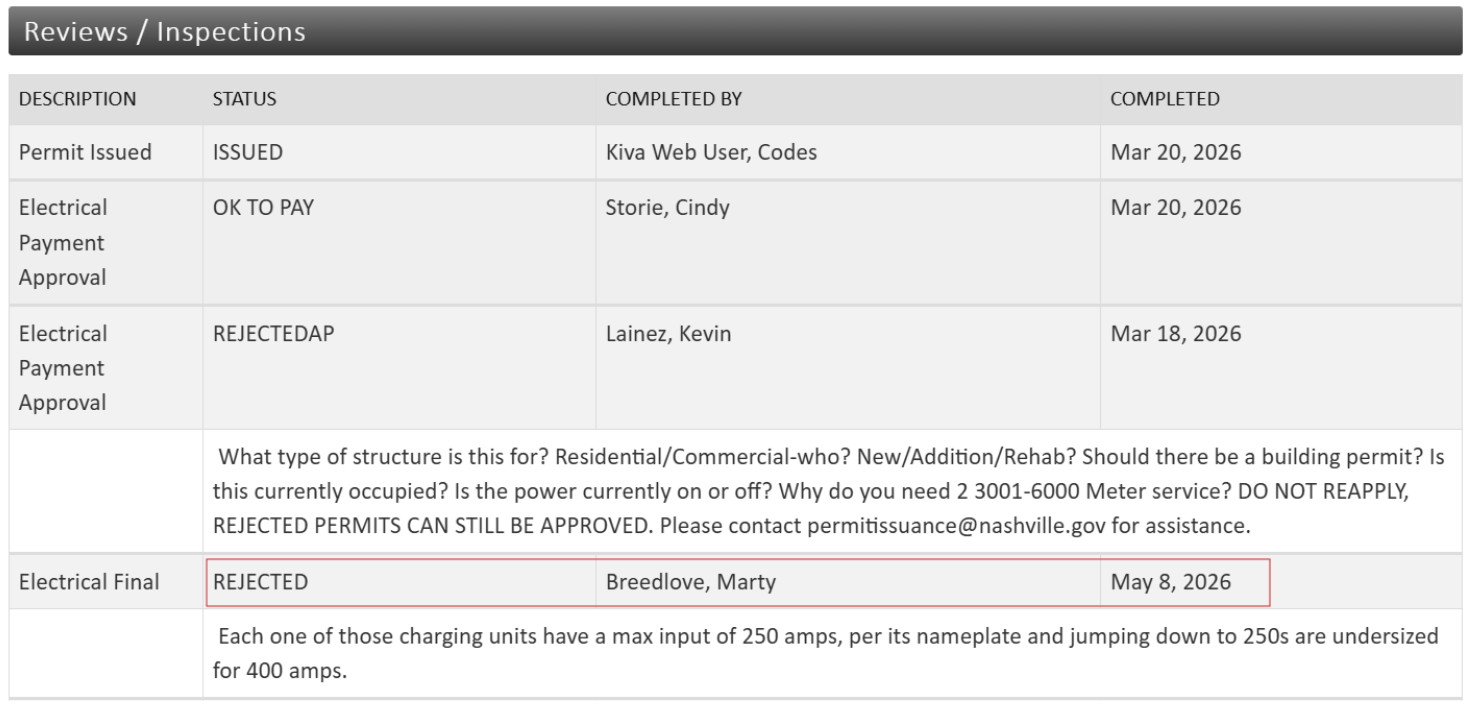
Lyft exited the autonomous race in 2021, at the very moment capital began flooding into the space. Since then it has been seeking to use other companies’ technology on terms that Lyft does not control.
The current policy environment is accelerating the pace of AV adoption with House committees advancing a federal autonomous commercial trucking framework (BUILD America 250 Act) and a separate congressional proposal under consideration (SELF DRIVE Act) for placing safety standards and regulations in a unified framework under federal jurisdiction. These proposals allow for national vs. city-by-city deployment planning, providing a path for carrying passengers during evaluation phases enabling revenue generation during pilots, and removing requirements around vehicle designs and manual controls such as steering wheels. The direction of travel, pace, and framework of autonomous adoption do not fit the hybrid-network AV strategy that Lyft has been advocating for.
Lyft’s 2027 Targets…. Rolling off in 2H’26
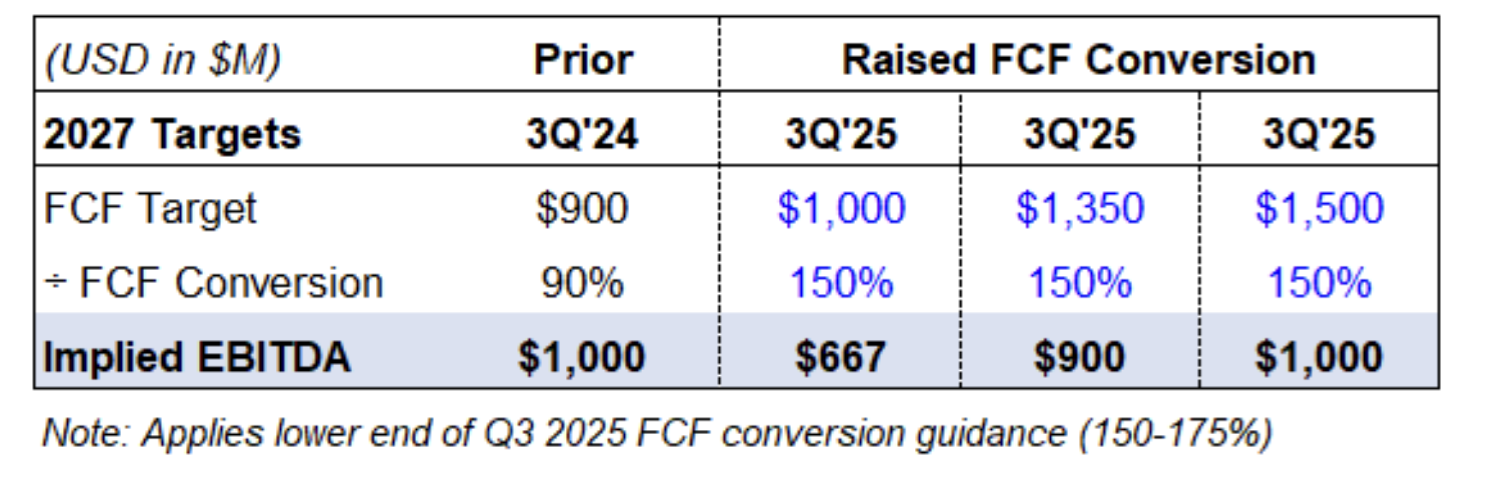
At its 2024 investor day, Lyft set multiple 2027 targets: a gross-bookings compound annual growth rate of roughly 15% from full-year 2024, an Adjusted EBITDA margin of about 4% of gross bookings on $1 billion of Adjusted EBITDA, and free cash flow conversion above 90% of Adjusted EBITDA targeting $900 million in Free Cash Flow (CFO - CapEx), alongside a separate $400 million advertising business revenue target:
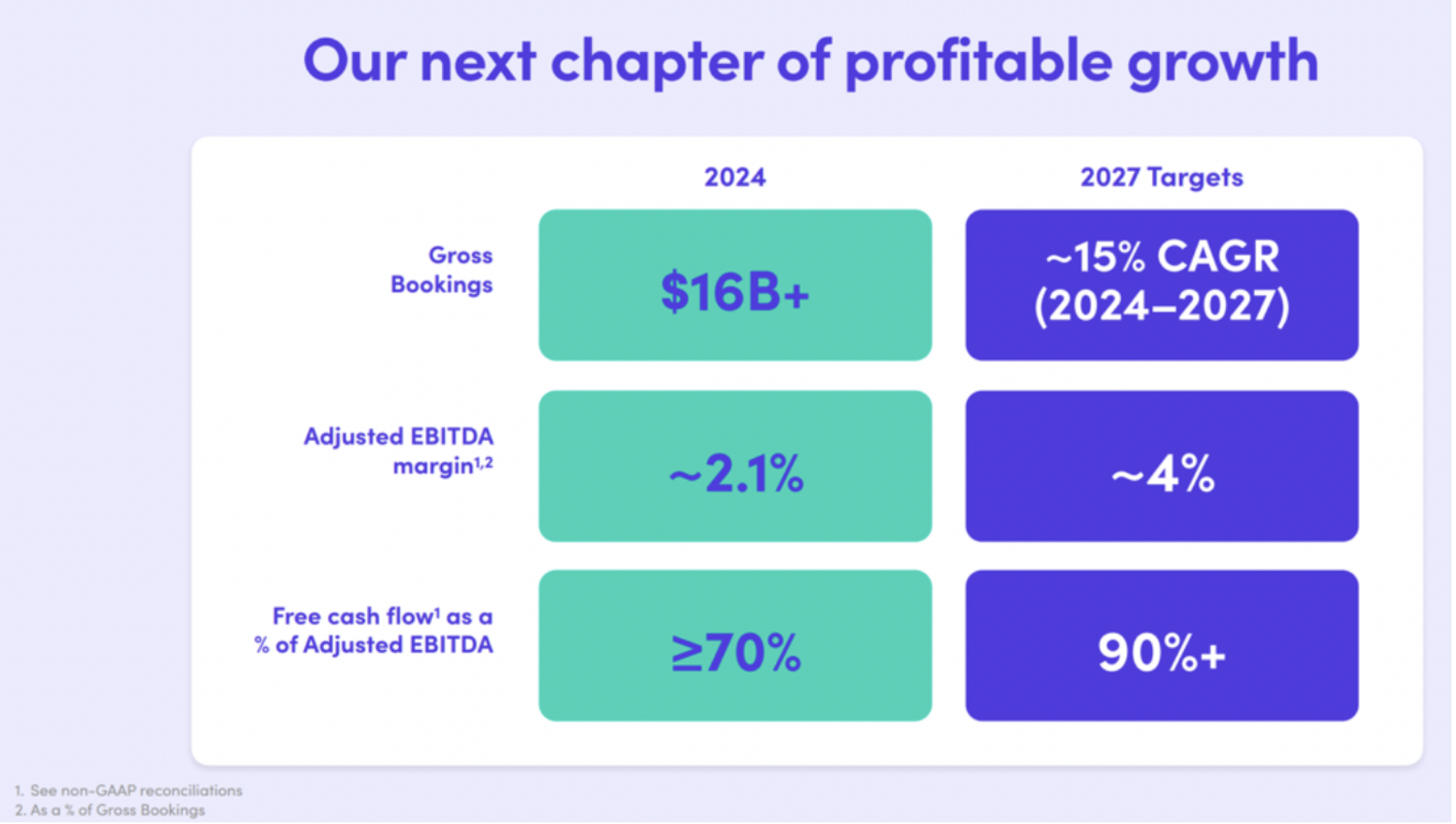
FY2024 bookings were about ~$16.1 billion; a 15% CAGR implies a 2027 target near ~$25 billion. Lyft optically looks to have done its part in 2025, growing bookings 15% to ~$18.5 billion, and Q1 2026 looked even better at roughly 19% growth. But that headline is inflated by several acquisitions, including FreeNow, which closed in April 2025 and adds roughly $1 billion of annual bookings.
That tailwind is about to disappear, and nothing of comparable size is replacing it. FreeNow begins lapping itself in Q2 2026 and is fully in both years' bases by the third quarter, at which point it adds minimally to the growth rate. Stripping it out brings Lyft's organic first-half growth is closer to 10% to 11% To hold the full-year rate near 15% into the back half without FreeNow, organic growth has to accelerate rather than decelerate. The problem is that Lyft's replacement acquisitions are far smaller: Gett UK, the annualizing TBR chauffeur book, and the Serveo bike contracts together add perhaps $150 to $175 million of bookings.
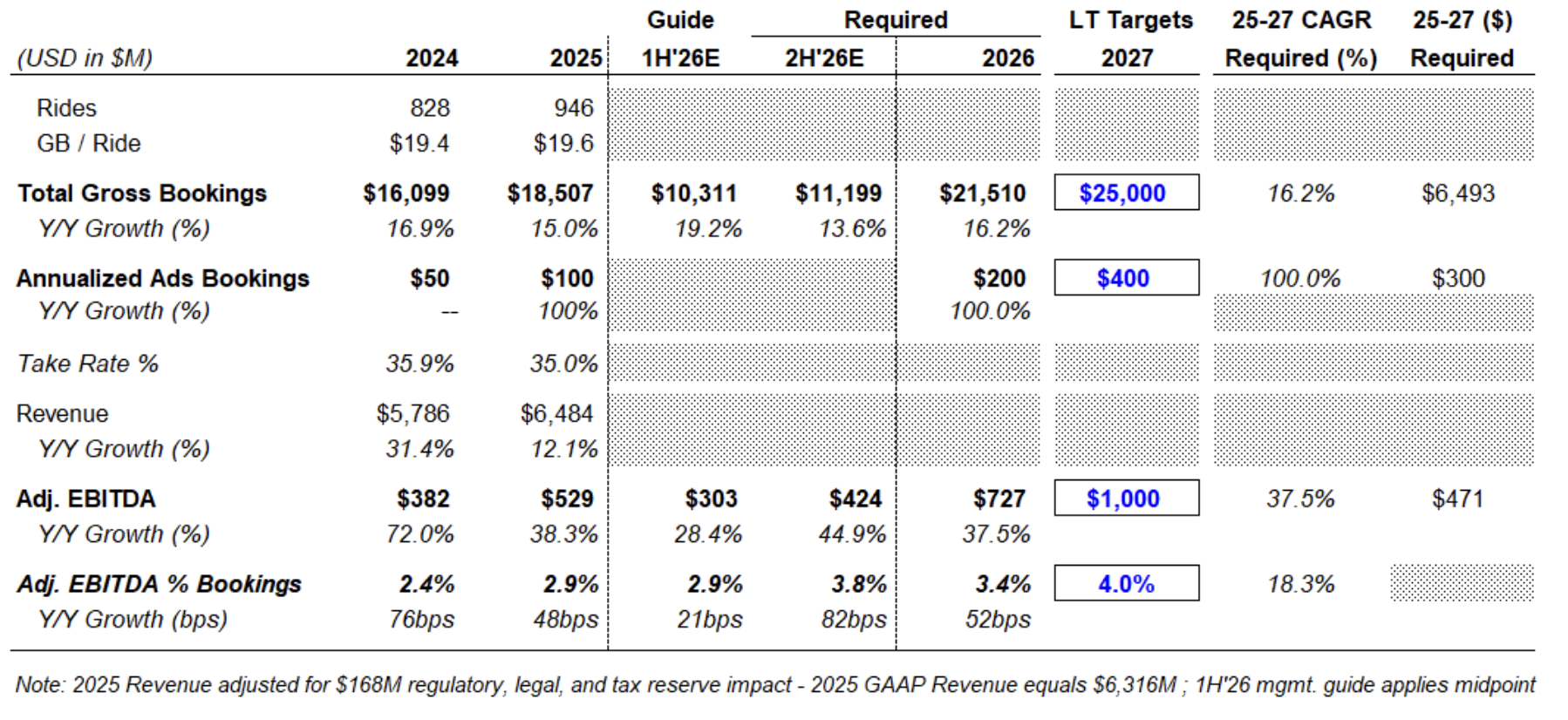
That gap now has to be filled by organic growth in North American rideshare, which is the segment losing share to Waymo and showing a sequential decline in active riders in the first quarter, even accounting for normal seasonality and apparent definitional changes to KPIs to incorporate recently acquired riders.
Lyft also set a $400 million advertising run rate revenue target for 2027. It exited 2024 at a $50 million run rate. On the Q1 2026 earnings call, management confirmed it hit $100 million in advertising run rate revenue in 2025, but declined to provide specifics about the 2026 run rate.
The 4% EBITDA margin target requires approximately 132 basis points of expansion from Lyft's current level as of Q1 2026.
However, Lyft is absorbing take-rate compression from European acquisitions, promotional activity, and future fleet management costs for Nashville logistics.These factors challenge the margin expansion story.
Lyft's Shifting Free Cash Flow Targets and Working Capital Movements Imply Negative Impact to EBITDA
In Q2 2024, management also guided to $900 million in free cash flow and a 90% conversion floor set as aspirational long-range plan metrics for 2027. That same year, however, the Company began ramping its net working capital allocations to insurance reserves and accrued expenses, resulting in elevated conversion rates, north of 200% in 2024.
When questioned about the unusual conversion dynamics on their Q3 2024 earnings call, management reiterated these were out of the ordinary in 2024, and investors should expect them to trend lower for 2025 and normalize towards the 90%-plus guide in the outer years:
“So looking further ahead, if you think about the near-term phase of our LRP, I think it's fair to assume that, that conversion in that near term, say, 2025 part would be a bit higher than 90%, but likely not as high as we're seeing here in 2024. And then as we move into the outer years of that LRP, we would expect that dynamic to normalize as insurance-related accruals and cash payments would be a little bit more balanced. So longer term, we believe that 90% plus adjusted EBITDA conversion target is appropriate.”
– Lyft Q3 2024 Earnings Call
However, just one year later, Lyft elevated its prior free cash flow conversion targets upwards without any material change to cost structure or acceleration in growth, stating free cash flow would be “well above $1 billion”, compared to the prior $900 million:
“As the business continues to grow, we will continue to grow our insurance reserves faster than our payout, a significant tailwind to free cash flow, resulting in elevated conversion levels not only in 2025, but also 2026 and 2027.”
“Importantly, our free cash flow generation remains robust, and we expect to deliver well above $1 billion again in 2026 and 2027, with conversion rates from Adjusted EBITDA in the range of 150-175%.”
– Lyft Q3 2025 Prepared Remarks
An increase in free cash flow conversion floor targets without sufficient corresponding growth in actual operating cash flow implies a guidance cut to previous 2027 EBITDA targets, as highlighted below.
Upon closer inspection, Lyft's early target achievements were not driven by actual economic operating gains, but by float mechanics from auto insurance reserves and the delayed timing of cash claims payments, elevated accounting allocations to accrual and reserve balances, and higher non-cash expenses including stock-based compensation.
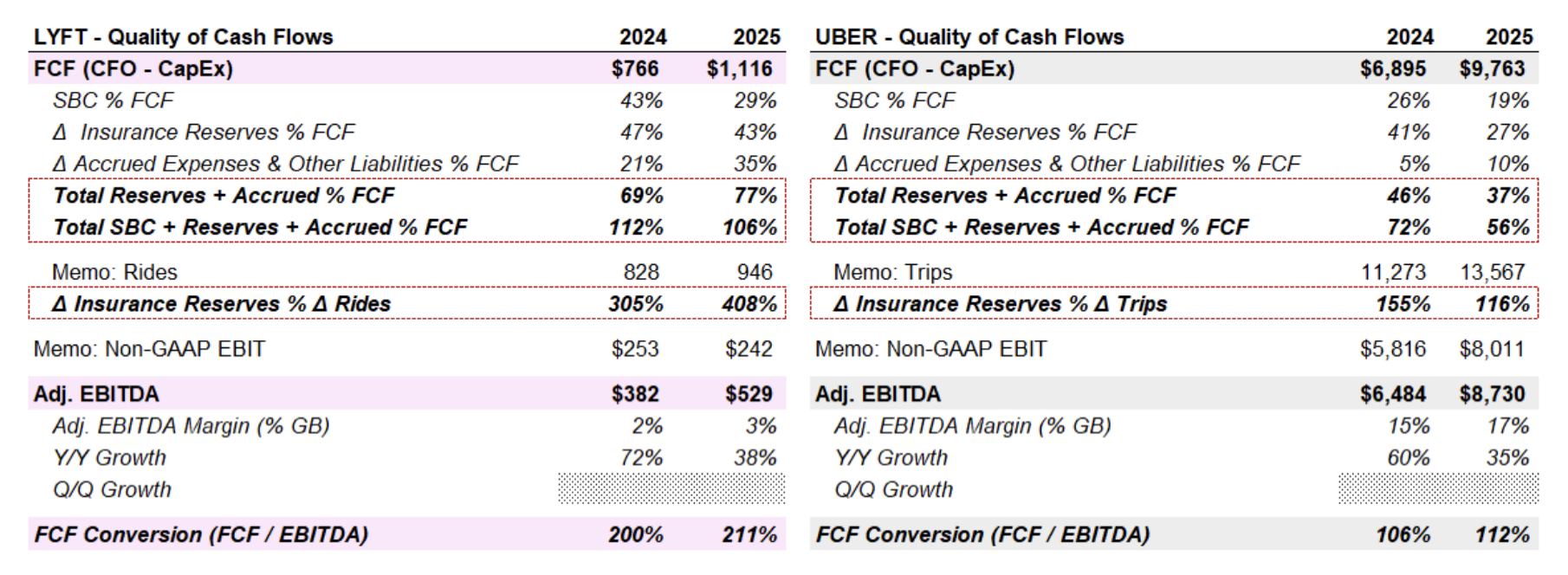
Uber has scaled ridership and achieved economic operating growth in the business: its total reserves and accruals relative to free cash flow have declined from ~46% to ~37%, while its commercial reserve build per trip has grown only moderately faster than trip count. In the same period that Lyft has grown ridership, its commercial auto reserves and accruals have raced in the opposite direction, with the total reserves and accruals ratio increasing from ~69% to ~77% from 2024 to 2025 and the commercial auto-driven reserves growing at 300-400% the number of incremental trips.
Management's long-term targets are ultimately tethered to continual growth of rides in the Lyft platform, but contractions and declines for subscale players create the exact opposite leverage effect when cash payouts originating from prior periods catch up to present insurance accrual and reserve choices.
In our view, Lyft has run out of manuvering room to avoid the liabilities, as well as the financial and business headwinds coming its way.
Terms of Use
Use of reports prepared by Bleecker Street Research LLC (“BSR”) and this website is subject to and governed by the below Terms of Use (the “Terms”). The Terms govern all reports published by BSR (each a “BSR Report”) and supersede any prior Terms of Use governing the access and use of this website and BSR Reports, which you may download from this website. By downloading, accessing, or viewing any materials on this website, you hereby agree to the following Terms.
Bleecker Street and Its Related Parties
BSR is under common control and affiliated with Bleecker Street Capital LLC (“BSC”), Bleecker Street Capital Management LLC (“BSCM”), and affiliated funds, including but not limited to Bleecker Street Minerva LP (“Minerva”) and Bleecker Street Partners LP (“BSP”) (collectively, BSC, BSCM, and affiliated funds, including Minerva and BSP, are referred to herein as “BSC”). BSR is an online research publication that produces due diligence-based reports on publicly traded securities, and BSC and BSCM are investment advisers registered with the U.S. Securities and Exchange Commission. The reports on this website are the property of BSR. BSR and BSC, collectively with their respective affiliates and related parties, including, but not limited to any principals, officers, directors, employees, members, clients, investors, consultants and agents, are referred herein to as “Bleecker Street”, “us”, or “we”.
BSR is a for-profit journalistic organization that researches and provides opinion journalism about issues of concern to the general public, including about the securities of public issuers. BSR finances its journalism through a non-traditional revenue model where it earns revenue from positions that BSC takes in the securities of issuers on which BSR reports. This business model requires Bleecker Street to take material financial risk, which our partners have exposure to. To manage risk, we must close open positions as we deem prudent. We do not provide “price targets” for securities, although we may express our subjective opinion of the value of a security, which differs from a price target in that we neither know nor claim to know how the market might value such security. We therefore typically do not hold, and provide no assurance that we will hold, a position in a reported-on security until it reaches a price target, nor do we necessarily hold, or provide any assurance that we will hold, positions in securities until such securities reach the price that reflects our opinion of value. Many factors enter into investment decisions aside from opinions of the value of the security, including without limitation, borrow cost, “short squeeze” potential, risk sizing relative to capital and volatility, reduced information asymmetry, the opportunity cost of capital, client expectations, the ability to hedge market risk, our perception of the efficacy of market regulators and gatekeepers, our perception of the resource imbalance between us and any Covered Issuer (defined below), and our subjective perceptions. Therefore, you should assume that upon publication of a report, we will, or have begun to, close a substantial portion – possibly the entirety – of our positions in the Covered Issuer’s securities.
Reports Are Solely Attributable to BSR
The BSR Reports on this website are opinion journalism. On this website and through the BSR Reports, BSR is providing its journalistic opinions about issues of concern to the general public. You understand and agree that the opinions, information, and reports set forth on this website are attributable only to BSR, which bears sole responsibility for the information on this website and content of the BSR Reports; provided, however, that persons affiliated with Bleecker Street have provided BSR with publicly available information that BSR has included in the BSR Reports and on this website, following BSR’s independent due diligence.
Website and Report Use Is at Your Own Risk
Any and all use of BSR’s research and BSR Reports is entirely at your own risk. Neither BSR nor BSC is liable for any losses or damages you may incur as a result of your use of this website, including but not limited to any direct or indirect trading losses you may incur as a result of any information on this website, any BSR research, or any BSR Report. You agree to do your own research and due diligence with respect to any information on this website, and to consult your own financial, legal, and tax advisors before making any investment decision with respect to transacting in any securities of an issuer discussed on this website (a “Covered Issuer”).
BSC’s Trading Practices and Positioning with Respect to Covered Issuers
As of the time and date of each report, BSC (defined below) is short the securities of, or derivatives linked to, the securities of the Covered Issuer, unless otherwise stated in the report. BSC therefore will realize significant gains in the event that the prices of a Covered Issuer’s securities decline. Upon the publication of each report, we may cover, and typically will cover, a substantial majority of our short positions. BSC’s covering its short positions upon the publication of a report is not a reflection of a lack of conviction in any opinions or the facts presented on this website or in any BSR Report. Rather, the act of covering BSC’s short positions upon the publication of a BSR Report is intended solely to manage risk in a prudent manner, consistent with the obligations of a fiduciary of our investors’ money. BSC are likely to continue transacting in the securities of Covered Issuer for an indefinite period after a report on a Covered Issuer, and we may be net short, net long or neutral positions in the Covered Issuer’s securities after the initial publication of a report, regardless of our initial position and views herein.
Notice to UK Residents
If you are in the United Kingdom, you confirm that you are accessing research and materials as or on behalf of: (a) an investment professional falling within Article 19 of the Financial Services and Markets Act 2000 (Financial Promotion) Order 2005 (the “FPO”); or (b) high net worth entity falling within Article 49 of the FPO (each a “Permitted Recipient”). In relation to the United Kingdom, the research and materials on this website are being issued only to, and are directed only at, persons who are Permitted Recipients and, without prejudice to any other restrictions or warnings set out in these Terms of Use, persons who are not Permitted Recipients must not act or rely on the information contained in any of the research or materials on this website.
No Recommendation or Solicitation; No Warranties
All information and opinions on this website and in BSR Reports are for informational purposes only. You understand and agree that no information on this website or in any BSR Report is investment advice or a recommendation or solicitation to buy securities. In any given BSR Report, BSR is solely articulating its reasons at the time of publication for the positions it may have in the securities of a Covered Issuer. To the best of BSR’s ability and belief, all information contained herein is accurate and reliable, and has been obtained from public sources we believe to be accurate and reliable, and who are not insiders or connected persons of the securities of a Covered Issuer or who may otherwise owe any fiduciary duty or duty of confidentiality to the Covered Issuer. However, such information is presented “as is,” without warranty of any kind, whether express or implied. BSR makes no representation, express or implied, as to the accuracy, timeliness, or completeness of any such information or with regard to the results to be obtained from its use. Research may contain forward-looking statements, estimates, projections, and opinions with respect to among other things, certain accounting, legal, and regulatory issues the issuer faces and the potential impact of those issues on its future business, financial condition, and results of operations, as well as more generally, the issuer’s anticipated operating performance, access to capital markets, market conditions, assets, and liabilities. Such statements, estimates, projections, and opinions may prove to be substantially inaccurate and are inherently subject to significant risks and uncertainties beyond BSR’s control. All expressions of opinion are subject to change without notice, and BSR does not commit to update or supplement any BSR Report or any of the information contained therein.
All Materials Copyrighted; Permitted Sharing
The information on this website, including but not limited to BSR Reports, are copyrighted and the intellectual property of BSR. You agree not to distribute any of the information on this website, whether as a downloaded file, a copy, an image, a reproduction, or a hyperlink to such file, in any manner other than by providing the following hyperlink: bleeckerstreetresearch.com. If you have obtained research published by BSR in any manner other than by downloading a file from the foregoing link, you hereby are on notice of these Terms, agree to these Terms, and agree not to use such research in a manner inconsistent with these Terms.
You further agree that you will not communicate or distribute the contents of BSR Reports and any other information on this site to any other person unless that person has agreed in writing to be bound by these Terms. You understand and agree that if you access this website, download or receive the contents of BSR Reports or other materials on this website as an agent for any other person, you are binding your principal to these Terms.
Limitation of Liability; No Special Damages
Bleecker Street shall not be liable for any claims, losses, costs, or damages of any kind, including direct, indirect, punitive, exemplary, incidental, special or consequential damages, arising out of or in any way connected with this website or the BSR Reports. This limitation of liability applies regardless of any negligence or gross negligence of Bleecker Street. You accept all risks in relying on the information and opinions in any report on this website.
Governing Law; Jurisdiction; Arbitration
You agree that any dispute between you and Bleecker Street arising from or related to these Terms, the information on this website, or any BSR Report shall be governed by the laws of the State of New York, without regard to any conflict of law provisions. You knowingly and independently agree to submit to the personal and exclusive jurisdiction of the state and federal courts located in New York, New York and waive your right to any other jurisdiction or applicable law. You agree that any dispute between you and Bleecker Street arising from or related to these Terms, the information on this website, or any BSR Report shall be brought exclusively in binding arbitration conducted in New York, New York by JAMS, before a single arbitrator, under the applicable JAMS rules. You agree that you waive the right to a trial by jury in any action or proceeding in any jurisdiction between you and Bleecker Street.
No Waiver; Validity
The failure of Bleecker Street Research LLC to exercise or enforce any right or provision of these Terms of Service shall not constitute a waiver of this right or provision. If any provision of these Terms of Service is found by a court of competent jurisdiction to be invalid, the parties nevertheless agree that the court should endeavor to give effect to the parties intentions as reflected in the provision and rule that the other provisions of these Terms of Service remain in full force and effect, in particular as to the foregoing governing law and jurisdiction provision.
One-Year Limitations Period
You agree that regardless of any statute or law to the contrary, any claim or cause of action arising out of or related to the use of this website or the material herein must be filed within one year after such claim or cause of action arose or be forever barred.